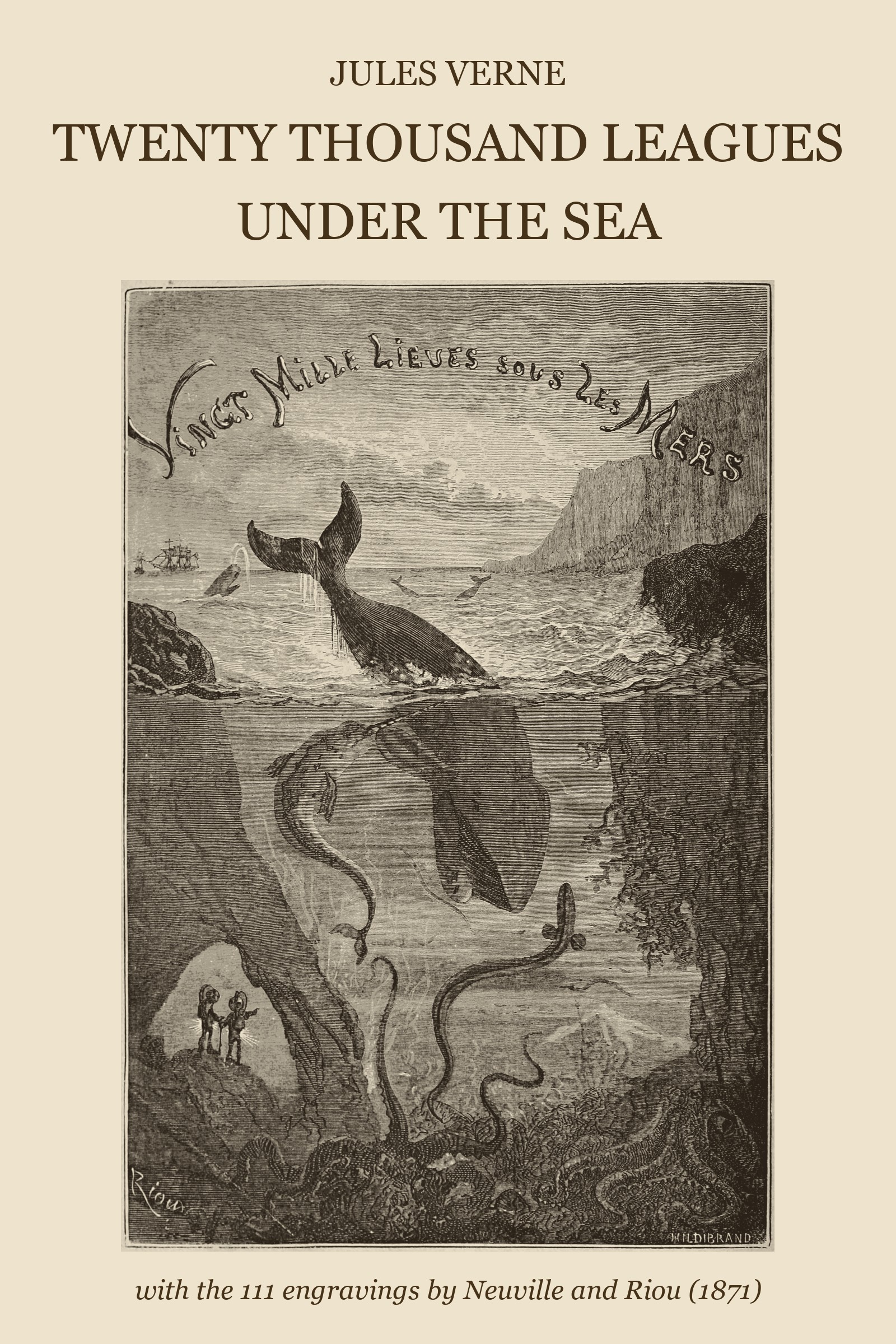
Twenty Thousand Leagues Under the Sea
Step inside Captain Nemo’s Nautilus in 3D, built from the figures Verne gives in the novel, and turn Nemo’s own calculations into forces you can see. The full novel is here too, in a new English translation from the 1871 Hetzel edition, with all 111 engravings by Alphonse de Neuville and Édouard Riou.
Narrated summary
A ten-minute journey through the book, narrated in English in Marcelo Rovai’s voice (OmniVoice), over the 1871 engravings, some of them animated.
720p version. The 1080p original can be downloaded from the releases page.
Twenty Thousand Leagues of Bathtub
A one-minute short for João Vicente, Marcelo Rovai’s grandson, who was born in October 2026 and has already received his first copy of Twenty Thousand Leagues Under the Sea from his grandfather.
A child who reads has imagination: one book is enough to turn a bathtub into a submarine. Every night before bed, Captain João boards the Nautilus: an empty bathtub, a cardboard periscope, and a stuffed octopus. Narrated in Marcelo Rovai’s voice, cloned with OmniVoice; images and video made in Google Flow (Nano Banana and Omni 1.2 Flash); script and direction generated by Claude, under the direction of Marcelo Rovai. 720p · 1 min 13 s. There is also the original in Portuguese.
Explore
The Nautilus and the physics behind it.
The Nautilus in 3D
A model of Captain Nemo’s submarine built from the measurements in Verne’s text. Rotate it, zoom in, open the compartments, and see the 1871 engraving for each one. Pilot it with the engine, the rudder, the diving planes, and the ballast tanks. Works best on a computer.
The physics of the Nautilus
In the Physics panel, the figures Nemo gives Aronnax in Part I, chapter XIII, become arrows drawn on the hull: weight, buoyancy, pressure, the force on the planes, thrust, and drag. Seven cards, from Archimedes to engine power, each with a scene to set up and questions for the class. The printable handout has room for answers and an answer key for the teacher.
The book
In English, and in Portuguese.
The complete novel, both parts and 47 chapters, translated from the French of the 1871 Hetzel edition, unabridged, with every engraving where it appears in the original. Free to read and share under the MIT License.
In Portuguese: read online, EPUB, PDF, and the narrated summary in Portuguese.
There is also a complete audiobook in Portuguese, 16 h 31 min in Marcelo Rovai’s voice: listen chapter by chapter in the online book, or download it as M4B or MP3.
Credits
How this work was made.
- Original text
- Jules Verne, Vingt mille lieues sous les mers, J. Hetzel edition, 1871, as published by Project Gutenberg (no. 54873).
- Engravings
- 111 drawings by Alphonse de Neuville and Édouard Riou, engraved by Hildibrand, from the same edition (public domain).
- 3D simulator
- Generated by Anthropic’s Claude Opus 5.5 under the direction of Marcelo Rovai, from Verne’s text and the engravings. The English version, including the quotations from Verne, was translated from the French by the same model.
- Translation
- The English and Portuguese translations were made from the French by Anthropic’s Claude Opus 5.5 under the direction of Marcelo Rovai.
- Narrated summary
- The English script, translated from the Portuguese video’s, and the new animation of the engravings were generated by Anthropic’s Claude Opus 5.5 under the direction of Marcelo Rovai, on the pipeline of the Portuguese video (made with Hermes/Qwen4). Narration by OmniVoice, cloned from Marcelo Rovai’s voice. Two scenes animated with the HappyHorse image-to-video model on Alibaba Cloud Model Studio, the others with procedural water and whirlpool motion.
- Audiobook (Portuguese)
- Narrated in Marcelo Rovai’s voice, cloned and generated locally on a Mac with OmniVoice; produced with the Hermes agent and the DeepSeek V4.1 Flash model, under his direction. The chapter player in the online book was generated by Anthropic’s Claude Opus 5.5 under his direction.
- Project
- Marcelo Rovai · mjrovai.com · code on GitHub